
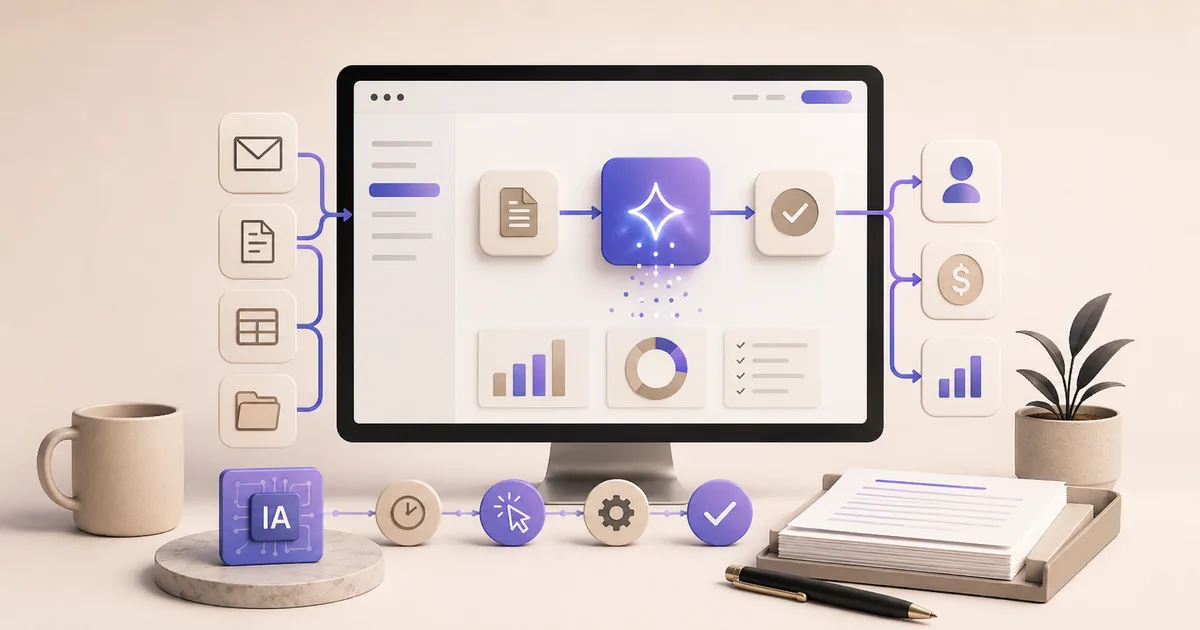
AI automation creates the most value in frequent, verifiable processes such as triage, data extraction, knowledge search, summaries, first drafts and CRM enrichment. Start with low-risk work, keep human review for sensitive actions and compare time, error rate and output quality before scaling the automation.
Small daily tasks can create significant cumulative value.
AI proposes; the workflow decides who validates.
Time, errors, cost and quality are compared.
Incoming enquiries
Classify forms and emails, enrich CRM records and route them to the right team.
What this changes in practice
In practice, this step should connect to Impact and Effort. Quantify current volume, time, delay and error rate. List data, integrations, process change and user training. This turns a preference into a testable project decision.
Bring Risk into the same review. Define the consequence of a wrong answer or action. For an SME, this reduces late rework, makes supplier scope easier to compare and connects the project to a commercial or operational outcome.
Document processing
Extract fields and missing items from invoices, forms and reports.
What this changes in practice
In practice, this step should connect to Effort and Risk. List data, integrations, process change and user training. Define the consequence of a wrong answer or action. This turns a preference into a testable project decision.
Bring Data into the same review. Review source quality, permissions, retention and ownership. For an SME, this reduces late rework, makes supplier scope easier to compare and connects the project to a commercial or operational outcome.
| Dimension | Question to ask | Good signal |
|---|---|---|
| Impact | Quantify current volume, time, delay and error rate. | Potential gain is measurable. |
| Effort | List data, integrations, process change and user training. | The pilot remains deliberately constrained. |
| Risk | Define the consequence of a wrong answer or action. | Sensitive outcomes require validation. |
| Data | Review source quality, permissions, retention and ownership. | The knowledge corpus has an owner. |
| Observability | Log inputs, outputs, approvals and failures. | Errors can be investigated. |
| Fallback | Provide a manual queue and graceful failure path. | The business process continues if the model is unavailable. |
Knowledge search
A RAG assistant answers from approved SOPs and displays sources.
What this changes in practice
In practice, this step should connect to Risk and Data. Define the consequence of a wrong answer or action. Review source quality, permissions, retention and ownership. This turns a preference into a testable project decision.
Bring Observability into the same review. Log inputs, outputs, approvals and failures. For an SME, this reduces late rework, makes supplier scope easier to compare and connects the project to a commercial or operational outcome.
Drafting and meeting notes
Prepare controlled drafts from CRM, ticket or meeting context.
What this changes in practice
In practice, this step should connect to Data and Observability. Review source quality, permissions, retention and ownership. Log inputs, outputs, approvals and failures. This turns a preference into a testable project decision.
Bring Fallback into the same review. Provide a manual queue and graceful failure path. For an SME, this reduces late rework, makes supplier scope easier to compare and connects the project to a commercial or operational outcome.
Reporting and follow-up
Automate reports, status reminders and quality checks.
What this changes in practice
In practice, this step should connect to Observability and Fallback. Log inputs, outputs, approvals and failures. Provide a manual queue and graceful failure path. This turns a preference into a testable project decision.
Bring Impact into the same review. Quantify current volume, time, delay and error rate. For an SME, this reduces late rework, makes supplier scope easier to compare and connects the project to a commercial or operational outcome.
AI as one step in a controlled workflow.
Applications, forms, CRM and knowledge sources are connected so model output can be checked and turned into a real business action.
See Automation & AI ↗ROI
Measure volume, current time, realistic automation rate, exceptions and maintenance.
What this changes in practice
In practice, this step should connect to Fallback and Impact. Provide a manual queue and graceful failure path. Quantify current volume, time, delay and error rate. This turns a preference into a testable project decision.
Bring Effort into the same review. List data, integrations, process change and user training. For an SME, this reduces late rework, makes supplier scope easier to compare and connects the project to a commercial or operational outcome.
Questions to settle before you start
Make the main unknowns visible before committing budget. An unanswered question is not a problem when it is explicit; it becomes a risk when it is hidden inside a supplier assumption and discovered during development.
Answer these questions with the people who will use, sell or operate the solution. Discovery then becomes an internal decision tool, not just a document sent to a supplier.
- How is impact handled today, and what should measurably improve after the change?
- How is effort handled today, and what should measurably improve after the change?
- How is risk handled today, and what should measurably improve after the change?
- How is data handled today, and what should measurably improve after the change?
- How is observability handled today, and what should measurably improve after the change?
- How is fallback handled today, and what should measurably improve after the change?
Common failure patterns and warning signs
The failure patterns below all push important decisions towards the end of the project, where change is more expensive. A strong process makes these risks visible early.
Use the warning signs as review criteria. If several appear at once, reduce scope, add discovery or validate a prototype before investing further.
- Leaving impact until the solution has already been built
- Leaving effort until the solution has already been built
- Leaving risk until the solution has already been built
- Leaving data until the solution has already been built
- Leaving observability until the solution has already been built
- Leaving fallback until the solution has already been built
Recommended action plan
A good decision should be measurable after launch. Establish a baseline, an owner and a review cadence, then compare the same indicators after launch.
A useful roadmap separates launch from evolution. Prioritise later work from usage data, leads, support tickets and operational gains instead of an old pre-project wish list.
- 1. Discovery — Goals, users and the current process.
- 2. Scope — Must-haves, assumptions and risks.
- 3. Prototype — Critical journey and key decisions.
- 4. Build — Content, data, technology and integrations.
- 5. Launch — Testing, analytics and ownership.
- 6. Improve — Usage, feedback and KPIs drive the roadmap.
Build the business case before comparing proposals
A project involving AI automation for SMEs: 7 processes to prioritise is easier to govern when it is framed as an investment rather than a feature list. Start with one measurable outcome: more qualified enquiries, less manual re-entry, a shorter sales cycle, greater user self-service or lower operational risk. Use that outcome to judge every scope decision that follows.
The first layer of the business case connects Impact with Effort. Quantify current volume, time, delay and error rate. List data, integrations, process change and user training. Quantify the current state where possible: enquiries per month, minutes per task, drop-off, licence cost, error volume or average cycle time. A reasonable baseline is more useful than a vague objective such as ‘modernisation’.
The second layer includes costs that appear after launch. Observability and Fallback therefore belong in the same decision as design and development. Log inputs, outputs, approvals and failures. Provide a manual queue and graceful failure path. A cheaper initial proposal can become more expensive if it leaves heavy manual work, unexpected licences or an architecture that is difficult to evolve.
Finally, assign value to risk reduction. Risk and Data often affect total cost more than expected. Define the consequence of a wrong answer or action. Review source quality, permissions, retention and ownership. The right question is not only ‘how much does it cost?’, but ‘what level of investment is proportionate to the outcome, the risk and the expected useful life?’.
Three scope scenarios to make the decision concrete
These scenarios are not price packages. They separate the essential need from medium-term ambition. A good proposal makes the layers visible so functions can be postponed without breaking the logic of the product.
Compare proposals without comparing apples and oranges
Two proposals with the same headline deliverable can cover very different realities. Ask suppliers to respond to the same scope, assumptions and definition of ‘done’. Price then becomes a consequence of visible choices instead of a number that is impossible to interpret.
Make responsibilities explicit as well: who provides content, who approves, who configures access, who migrates data, who tests, who hosts and who responds after launch? Grey areas are often the first source of budget and timeline overruns.
| Criterion | What to review | Evidence to expect |
|---|---|---|
| Impact | Quantify current volume, time, delay and error rate. | Potential gain is measurable. |
| Effort | List data, integrations, process change and user training. | The pilot remains deliberately constrained. |
| Risk | Define the consequence of a wrong answer or action. | Sensitive outcomes require validation. |
| Data | Review source quality, permissions, retention and ownership. | The knowledge corpus has an owner. |
| Observability | Log inputs, outputs, approvals and failures. | Errors can be investigated. |
| Fallback | Provide a manual queue and graceful failure path. | The business process continues if the model is unavailable. |
Measure value after launch
Measurement starts before launch. Choose two to four KPIs that come directly from the business case, record the current baseline and assign someone to review them after 30, 60 and 90 days. For Impact and Effort, favour indicators that show changed behaviour or business outcomes rather than traffic alone.
Add quality indicators around Risk and Data. A product can convert more while creating more errors or support demand; an automation can save time without improving the experience. Use several dimensions of value rather than a single vanity metric.
Finally, connect Observability and Fallback to operating cost: licences, administration time, tickets, maintenance and required enhancements. After a few months you will have enough evidence to decide whether to invest further, simplify or expand the solution.
- Conversion or adoption
- Time saved
- Quality / error rate
- Cycle time
- Operating cost
- User satisfaction
How ready are you?
Are you ready to move forward?
Frequently asked questions
Start with a chatbot?+
Not necessarily; back-office automation often pays back faster.
Use internal documents?+
Yes, with RAG, permissions and governance.
Limit hallucinations?+
Constrain scope, require sources and validate sensitive output.
How large should the first release be?+
Large enough to support one valuable journey end to end, small enough to test and improve quickly.
What needs to happen after launch?+
Monitoring, support, ownership and a roadmap are part of the solution, not just the delivery project.